





What is an APP License Plate? 2026 Penalties, Replacement, and Inspection Guide
.

What is an APP License Plate? 2026 Penalties, Replacement, and Inspection Guide
Aesthetic plates installed for custom looks have now become an issue that goes far beyond a direct traffic fine. Law No. 7574, published in the Official Gazette dated February 27, 2026, classified unsealed APP plates under the scope of counterfeit plates and increased the administrative fine to 140,000 TL. As of April 1, 2026, the tolerance period has also closed. For fleet operators, this means that plate compliance is becoming a part of daily operations.
Plate legislation in Turkey has undergone two major updates in the last two years. First is the QR code requirement that entered into force as of January 1, 2024. Second is Law No. 7574, which came into effect on February 27, 2026, and radically amended Article 23 of the Highways Traffic Law No. 2918. When evaluated together, the APP plate issue ceases to be merely a matter of visual preference. EDS (Electronic Detection System) and Plate Recognition Systems (PTS) have been updated, and every registration plate that does not possess the TŞOF seal is considered a counterfeit document in the eyes of the legislation. This guide addresses the aspects of what the topic is, how much the fine is, how to appeal, and how to replace them, in order.
1. What is an APP Plate? What is its Expansion and What are the Technical Differences from a Standard Plate?
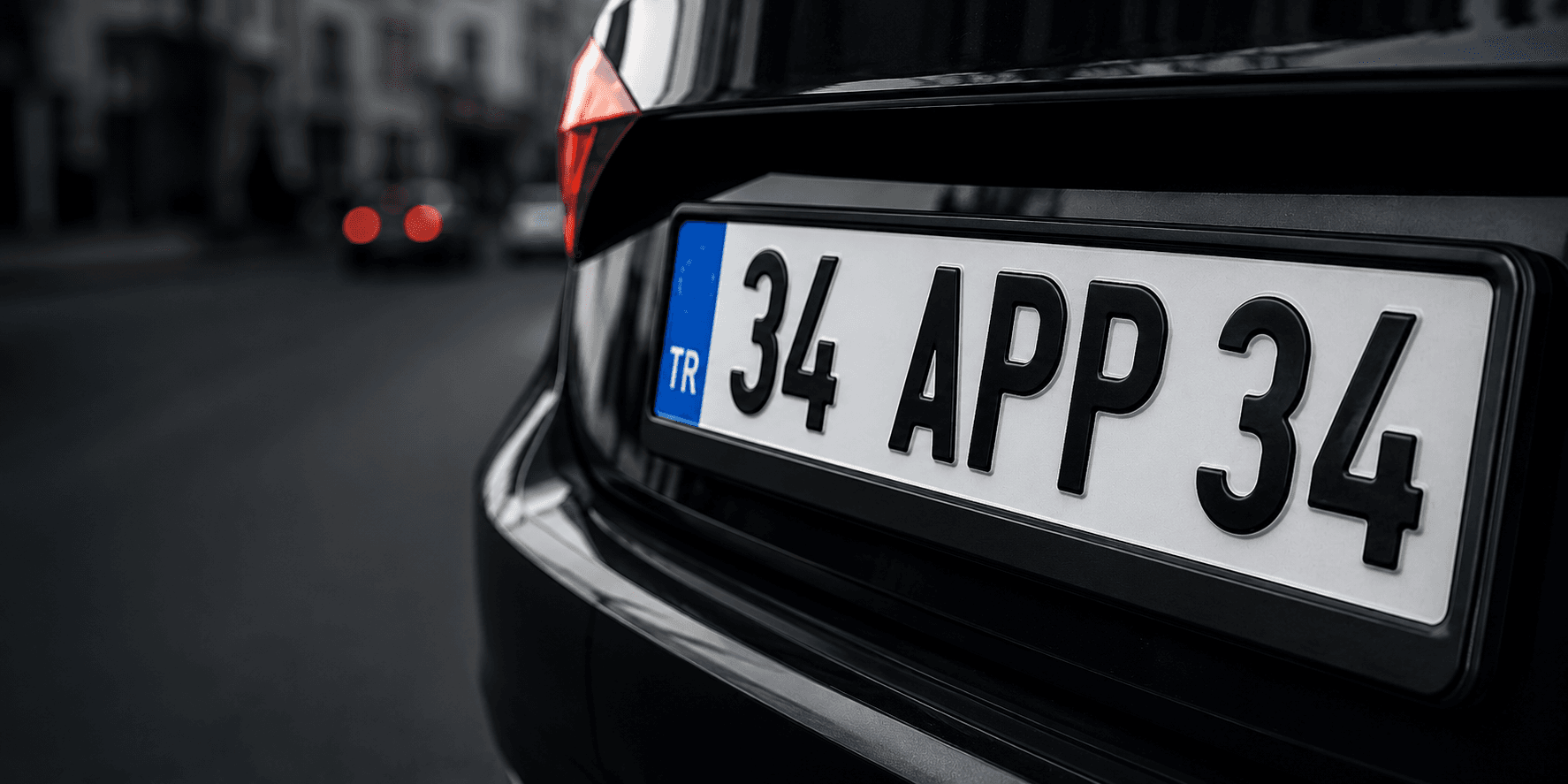
The answer to the question of what an APP plate is can be given as: "a modified plate printed with acrylic or thick font materials, without a frame, and usually in unauthorized workshops, instead of the standard 11x52 cm aluminum registration plate." These plates do not feature official security elements such as the TŞOF (Turkish Drivers and Automobile Drivers Federation) cold stamp, wavy TR hologram, and QR code.
1.1 APP Plate Expansion
The expansion of APP plate stands for American/European Press Plate. The name comes from the printing technique of the plate. Instead of the forged aluminum in standard plates, it is produced from acrylic or another material by pressing method, creating a look that makes the letters appear thick.
1.2 Technical Differences Between Standard Plates and APP Plates
Although the two plate types look similar at first glance, they differentiate across six official security elements: material, font, seal, hologram, QR code, and EDS readability. The table below directly compares these differences.
Common Misconception: Sealed plates purchased on the internet are not legal.
The Truth: A large portion of the plates sold on social media with titles like "sealed APP plate, guaranteed printing" are the production of unauthorized workshops. Since the seal is an imitation or not a cold stamp, it falls under the scope of counterfeit plates during Police inspection. Legal plates are printed only in authorized workshops affiliated with TŞOF.
2. Why is an APP Plate Considered Banned?
APP plates are banned because the non-standard font and material structure prevent traffic inspection systems, especially EDS, from reading the plate correctly. The legislation evaluates this non-compliance in two categories: degradation of camera reading and disruption of vehicle tracking in judicial investigations.
2.1 Camera and EDS Systems Misread the Plate
Thick, adjacent, or italic characters are flagged as deviated data by PTS software. The result: Highway toll fees can be billed to a different plate, speed violations can be attributed to another vehicle, and sometimes the plate cannot be read at all.
In spots with dense camera networks like Istanbul traffic, this situation means more than one wrong record per day for a driver.
2.2 Vehicle Tracking Becomes Difficult in Judicial Investigations
Non-standard plates directly slow down investigation processes such as accident detection, stolen vehicle searches, and suspect tracking. This security gap is the main reason why the legislation does not accept aesthetic justifications.
3. How Did the 2026 Inspection Process and Transition Period Work?
The year 2026 was carried out by EGM via a three-stage calendar: the law was published on February 27, followed by an information period granted until April 1, and as of April 1, the zero-tolerance period began. Fines issued during this timeframe were retroactively cancelled.
3.1 Information Period: February 27 - April 1, 2026
When confusion arose during the first weeks of the law's publication, the Ministry of Interior introduced a temporary practice. Administrative fines issued within this scope between February 27, 2026, and April 1, 2026, were cancelled. In the field, priority was given to guidance and directing drivers.
3.2 Zero Tolerance After April 1, 2026
The answer to the question of whether there is an APP plate fine after April 1, 2026, is clear: yes, and it is applied without compromise. EDS software has been updated to automatically detect thick font plates. PTS cameras in metropolitan cities switched to full capacity with the new software. When EDS detects a plate as non-standard, the fine report is issued digitally.
4. 2026 APP Plate Fines and Penalties Table
The 2026 legislation evaluates plates in two categories: an administrative fine of 140,000 TL (KTK 23/5-b) is applied to unsealed APP plates without a TŞOF seal, and an administrative fine of 4,000 TL (KTK 23/3) is applied to plates that have a TŞOF seal but are non-standard in size or font. The difference between the two fines reaches 35 times.
Sanction Item
Unsealed APP Plate (KTK 23/5-b)
Sealed Non-Standard Plate (KTK 23/3)
Administrative fine
140,000 TL
4,000 TL
Recurrence fine (Within 1 year)
280,000 TL
4,000 TL again
Early payment discount (15 days)
25% discount, 105,000 TL
25% discount, 3,000 TL
Confiscation of driver's license
30 days, 60 days on recurrence
Not applied
Ban from traffic
30 days, 60 days on recurrence
Until the plate becomes legal
Correction period
Not granted
7 days
TCK 204 (Forgery of official document)
Judicial process demanding 2 to 5 years in prison
Not applied
TÜVTÜRK inspection status
Heavy defect, cannot pass
Heavy defect, cannot pass
Appealing authority and period
Criminal Judicature of Peace, 15 days
Criminal Judicature of Peace, 15 days
4.1 Unsealed APP Plate: KTK 23/5-b Scope
This category covers unsealed plates printed in unauthorized workshops and contains a four-stage sanction.
4.2 Sealed But Non-Standard Plate: KTK 23/3 Scope
In this category, the plate was printed by an authorized institution, but its font has been thickened or its size has been changed. The sanction table is much lighter.
Administrative fine: 4,000 TL.
Correction period: 7 days are given to make the plate legal.
Ban from traffic: If it is not corrected within the period, the vehicle is impounded.
4.3 TÜVTÜRK Inspection Result
A vehicle with an APP plate fails the TÜVTÜRK inspection due to a heavy defect. For fleet vehicles, this means direct withdrawal from operations. In a healthy fleet management process, plate compliance is regularly monitored along with the inspection schedule.
Editor's Note: Definitely check whether the article in the report is written correctly. The difference in fine between KTK 23/3 and KTK 23/5-b is 35 times. At the appeal stage, the first point to look at is from which article the fine was issued.
5. How Does the APP Plate Fine Appeal Process Work?
The appeal is made by submitting a petition to the Criminal Judicature of Peace within 15 days from the notification of the fine report. The application can be forwarded in person, via e-Government, or through UYAP. With the correct documents, a fine of 140,000 TL can be reduced to 4,000 TL or completely cancelled.
5.1 Early Payment Discount and the Right to Appeal
Paying the fine with a discount within 15 days does not close the right to appeal. When the appeal is found justified, the paid amount is refunded with interest. For businesses that rent company vehicles, car rental advantages include the direct handling of such administrative processes by the rental firm. The legal process can be initiated without disrupting cash flow.
5.2 Valid Grounds for Cancellation
The strongest ground in the appeal is the origin of the plate. The following four situations constitute the basic justifications of the defense.
6. Steps to Transition from an APP Plate to a Legal Plate
There are two ways to transition to a legal plate: those who have their original plates dismantle the APP plate and attach their old plates; those who do not have them follow a four-step procedure consisting of a police report, notary transaction, and TŞOF printing.
6.1 Fast Track for Those Who Have Their Original Plates
Dismantling and destroying the APP plate and re-attaching the old legal plate is sufficient. No official application is required. This is the fastest and cost-free solution. For lessees who use their vehicle through a fleet rental company, the plate replacement process runs directly under the responsibility of the rental firm.
6.2 Four-Step Procedure for Those Who Do Not Have Their Original Plates
If the old plate does not exist, it is necessary to operate the transition process in the following order.
6.3 In Which Case is Free Replacement Valid?
If the plate was printed through legal channels with the TŞOF seal but carries a defect such as font thickness during printing, the Chamber of Drivers renews the plate free of charge without requesting a request document. Under-the-counter counterfeit plates do not fall under this scope.
7. QR Code (Quick Response Code) Requirement on Plates
A QR code and a 12-digit serial number are mandatory on all plates registered, changing hands, or renewed after January 1, 2024. For those using their current legal plates, there is no urgent replacement requirement until 2027.
7.1 Verification Provided by the QR Code
Traffic teams scan the QR code with smart devices. Information on when and in which workshop the plate was printed, and the chassis information of the vehicle can be verified within seconds. A significant portion of counterfeit plate and stolen vehicle cases are resolved in this way during the field stage. The plate being verifiable is also a prerequisite for the smooth processing of motor insurance and traffic insurance compensations within the scope of car rental insurance types.
Common Misconception: "Every plate that has a QR code is legal."
The Truth: A QR code alone is not considered an indicator of legality. Unauthorized workshops can also print a fake QR code visual on the plate. The actual verification takes place in the process where the code is scanned by traffic teams and matched with TŞOF records.
8. APP Plate Risk for Companies Managing Fleets
An APP plate creates a different risk for a company operating multiple vehicles than for an individual driver. Banning a single vehicle from traffic means an interruption that directly breaks the delivery chain and strains customer relations.
For businesses that prefer commercial vehicle rental, the issue of plate compliance completely leaves the agenda of the business. All vehicles in the fleet are delivered with full compliance with the TŞOF seal, hologram, and QR code. The legal compliance of the vehicle remains the obligation of the rental company, not the lessee company.
The long-term car rental model carries this guarantee to a wider scope. In addition to plate tracking, inspection, insurance management, maintenance, and vehicle replacement are also gathered under the same contract. Driver discipline and plate control become part of the operational discipline reflected in the field.
In Hedef Filo processes, the plate side operates through the following three headings.
The same standard applies to the electric vehicle rental portfolio. Technical features in the green plate application are followed with the same meticulousness. Plate non-compliance in EV vehicles benefiting from SCT and MTV advantages can also put these tax advantages at risk.
9. Quick Decision Steps for Drivers
For a driver who realizes that there is an APP plate on their vehicle or suspects the vehicle they will purchase, the order to follow consists of these five steps.
The Way to Remove Plate Compliance from Company Risk
Although the APP plate seems like an aesthetic choice for an individual driver, the legislation clearly places it in the category of counterfeit plates. When an administrative fine of 140,000 TL, a 30-day driver's license cancellation, and the judicial process within the scope of TCK 204 come together, the picture yields serious consequences.
For fleet operators, the issue has an extra dimension: operational continuity. Banning a vehicle from traffic shakes the delivery schedule and strains customer relations. Hedef Filo guarantees plate compliance at all stages, from the vehicle delivery process to daily operations, and keeps your company away from this risk.
You can contact Hedef Filo experts to configure your fleet structure independently of plate, insurance, and administrative processes.
